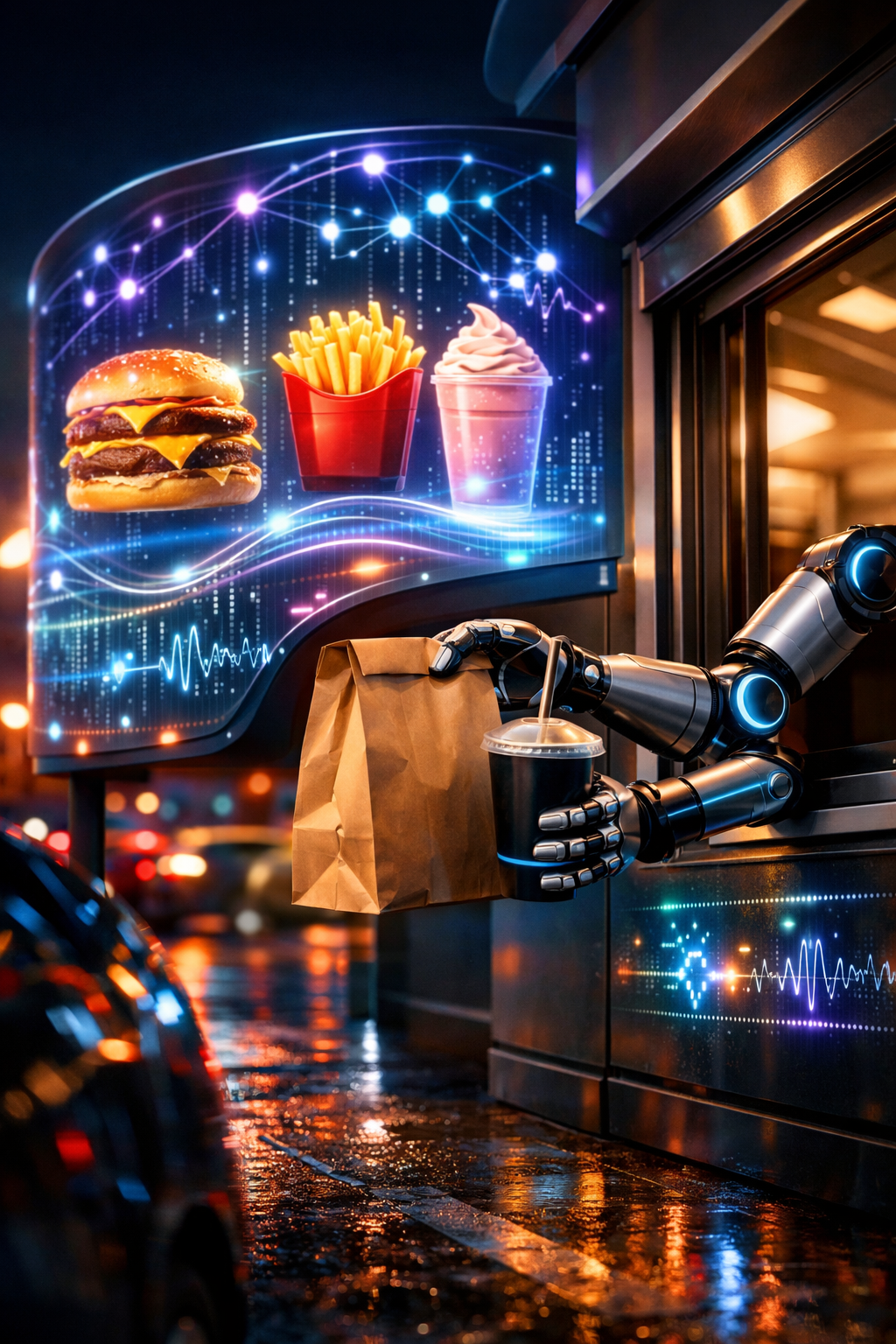
You pull up to the drive-thru, roll down your window, and shout your order over the rumble of an idling engine. A cheerful, perfectly modulated voice confirms your complex request—extra pickles, no onions, Diet Coke instead of fries—and the total flashes on the digital board.
You drive forward, entirely unaware that you didn't just speak to a human wearing a headset. You just interacted with a highly orchestrated stack of Automatic Speech Recognition, natural language processing, and edge computing.
The AI drive-thru is no longer a concept video; it is rapidly becoming the operational standard for the quick-service restaurant (QSR) industry. But to understand why this shift is happening, we have to look past the novelty of a talking robot. We have to look at the brutal economics of fast food, the changing landscape of labor laws, and the complex technology required to make it all work in under sixty (sometimes thirty) seconds.
The Anatomy of an AI Drive-Thru
A fully automated drive-thru is not a single product. It is a layered automation system where voice AI takes the order, computer vision watches the lane, and predictive analytics decides what should happen next.
1. The Voice Layer: The most visible element is the voice agent. Modern deployments—like Wendy’s FreshAI or Taco Bell’s voice rollouts rely on a complex stack of Automatic Speech Recognition (ASR) to turn audio into text, Natural Language Processing (NLP) to extract intent, and Text-to-Speech (TTS) to reply.
The hardest engineering challenge here isn't the AI; it is the acoustics. The system uses directional microphones and intense noise suppression to filter out wind, sirens, and screaming kids in the backseat. The AI must be specifically tuned to parse regional accents, colloquialisms, and sudden mid-sentence order changes.
2. The Vision Layer: While the voice agent handles the transaction, computer vision systems act as the silent manager. Edge-computed cameras track vehicles, measure queue lengths, and calculate dwell times. Inside the restaurant, vision sensors can monitor the kitchen line, verifying that the correct items are placed in the bag before it goes out the window, effectively acting as an automated quality-assurance layer.
3. The Predictive Layer: Behind the scenes, machine learning models analyze historical sales, weather patterns, and real-time lane congestion to forecast demand. If the vision layer detects a ten-car backup, the predictive AI can dynamically alter the digital menu board to highlight items with faster prep times, keeping the line moving.
4. Edge Hardware and Deep Integration None of this works in the cloud. Drive-thru interactions require sub-second latency; a restaurant cannot wait for a data packet to travel to an AWS server and back while a customer is tapping their steering wheel. Because of this, the entire stack relies heavily on edge compute devices installed directly inside the restaurant.
Furthermore, the intelligence must integrate seamlessly with the restaurant's operational nervous system. The AI connects directly to the POS and kitchen display systems. By removing the human middleman from data entry, operators see an immediate impact on core performance metrics. When an AI perfectly parses a complex modifier and injects it straight into the database, it inherently drives down check void rates and stabilizes overall transaction conversion percentages.
The Economics of Automation
Why are massive operators pushing so hard for this technology? The answer lies in the collision of labor costs and operational throughput.
In markets like California, the minimum wage for fast-food workers recently jumped to $20 an hour. When labor reaches that price point, the capital expenditure required to install new technology shifts from an expensive luxury to an economic necessity.
However, the goal isn't necessarily to completely eliminate the workforce. Fast food is currently facing historic turnover and chronic understaffing. AI allows operators to reallocate their limited human labor away from the stressful, repetitive task of taking orders and shift them toward higher-value fulfillment—actually cooking and bagging the food. The AI handles the data ingestion; the human handles the physical output.
The Consumer Friction (And Why It Doesn't Matter)
If you spend time online, you have likely seen viral videos of drive-thru AIs malfunctioning—adding twenty orders of McNuggets to a bill or completely failing to understand a simple request. Consumers are naturally skeptical. There is an inherent friction when people feel they have to perform or over-enunciate for a machine, and many simply prefer the grace and flexibility of a human interaction.
But ultimately, consumer sentiment may not dictate the outcome.
Fast food is a game of margins, speed, and volume. If an integrated AI stack can shave ten seconds off the average drive-thru time, reduce the percentage of voided items, and dynamically upsell a larger drink 15% more effectively than a teenage cashier, the financial gravity is too strong to ignore.
The AI drive-thru will inevitably experience growing pains. There will be edge cases, misheard modifiers, and frustrated drivers demanding to speak to a human. But the technology is learning with every single transaction. The systems are getting faster, the edge compute is getting cheaper, and the labor market is not reversing course.